
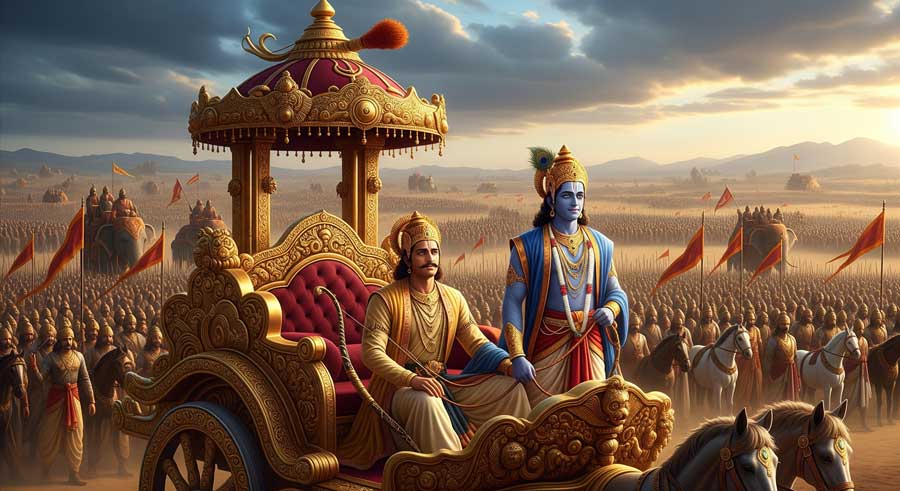
Every event that happens in the world is absorbed by the image of Krishna. Krishna is a Great Yogi, and we all become enlightened only through some part of the whole. But Krishna is a Yogi who unites in Himself the whole Universe, all art. In order to make yoga closer to people, He descended to us, to Earth. If you truly immerse yourself in the study of yoga, you will see the image of Krishna.
Krishna creates illusory images. When He unites with Maya, He appears to be an ordinary person. All this happens right before your eyes, and we have also witnessed these events. We should not doubt, because only faith can show us the true path. We have been convinced of this truth many times. People think that the stories about Krishna are just fairy tales, legends. But in fact, Krishna surpassed even the gods in the art of yoga. If you remove Krishna from the yoga system, nothing will be left of this system. Krishna is not a product of someone's sick imagination, He is the crown of the fantasies of our entire world. Universal love depends on Him. In love, there is a place for attachment, imagination, and reflection. Emotions are created from this, and feelings are created from them. All of us in this world are different incarnations of the Great Maya. And the highest level of development of the Great Illusion, Maya, is the God Krishna. The other side of His image is His living, earthly incarnation. After all, we are all people. Therefore, we can say that we are all like Krishna, and Krishna is not just an object of our worship. Krishna is present in all physical forms. The form attracts us, and it is the form that determines our path. But all our paths, one way or another, meet at the crossroads. And for each of us, such a crossroads can become a certain stage on the path of life. Krishna is our path.
The role of Krishna in yoga cannot be overestimated. We can think of Him as simply the hero of a love story. Think for a moment, what is the difference between Shiva and Krishna? One is calm, the other is always immersed in play. They are two sides of the same coin. Together they form the circle of advaita, complementing each other. After all, if there were no play, there would be no calm. There is a certain need and there is something that satisfies it. This is what creates the face of our world. Otherwise, we would not strive for anything.
(Said by Mahavatar Babaji.
From Pilot Babaji's book "Discover the Secrets of the Himalayas")
The Bhagavad Gita is one of the most important sacred texts not only of Hinduism but also of the whole world. It consists of 700 verses-shlokas, and is part of the great epic Mahabharata, which itself has about 100,000 shlokas. Everything that was described in these Puranas happened 5 thousand years ago. I will briefly tell you the background of the Bhagavad Gita itself and the battle of Kurukshetra.
Dhritarashtra, the eldest son of King Vichitravirya, was denied the opportunity to be the king of Hastinapur. Dhritarashtra was blind from birth, and therefore his younger brother Pandu was declared king.
Pandu, having become the king of Hastinapur and later the emperor, was forced to leave Hastinapur together with his two wives Kunti and Madri. He went to atone for his grave sin, as he accidentally shot and killed the sage Kindama and his wife with an arrow while hunting. Before his death, the sage cursed Pandu. In Pandu's absence, the kingship of Hastinapur was temporarily given to the blind Dhritarashtra.
Pandu had no children yet, but Kunti used the mantra given to her by the sage Durvasa, and thus Yudhishthira, Bhima, and Arjuna were born. Kunti also shared this gift with Madri, and she gave birth to the twins Nakul and Sahadev. But the curse of the dying sage Kindama came true and Pandu eventually died. Pandu's wife Madri followed with him.
Kunti was left alone with five children and after some time returned to Hastinapur. Yudhishthira, the eldest son of Pandu, was supposed to inherit the emperor's throne upon reaching adulthood, since his father Pandu was the actual emperor, but Dhritarashtra was in no hurry. He has seen his eldest son Duryodhana, who had grown up with the thought that he would be the king of Hastinapur, in the place of the future king.
The sons of Pandu and the sons of Dhritarashtra grew up, and the problem grew with them. The question of who would be king became more and more acute. By all rights, it should have been the eldest son of Pandu, Yudhishthira. But Dhritarashtra and his son Duryodhana had completely different intentions.
Duryodhana did many things to destroy the five Pandavas, but Yudhisthira, Bhima, Arjuna, Nakula, and Sahadeva, along with their mother Kunti, always remained unharmed. Duryodhana resorted to various tricks to remove his competitor from the path to the royal crown.
Over time, the issue of the throne was resolved and Yudhishthira became king, and then emperor, not of Hastinapur, but of Indraprasth. However, Duryodhana could not reconcile himself to this and constantly created problems for the Pandavas.
Once he arranged a dice game for the emperor Yudhishthira and he lost to Duryodhana his entire kingdom, crown, his four brothers, and in addition he also lost his wife Draupadi. But this loss was replaced by a punishment in the form of a fourteen-year exile of the five Pandavas. And when the Pandavas fulfilled all the conditions of the punishment, and after fourteen years of exile returned with their wife Draupadi, Duryodhana did not give anything back. Duryodhana declared that the Pandavas had violated the terms of the punishment and insisted on continuing the exile for another 14 years. Krishna offered Duryodhana to give the five Pandavas five villages where they could live and reign, and then Yudhishthira and his brothers would renounce the kingdom and everything to which they have a legal right. But pride and ego clouded Duryodhana's mind, and he did not yield and refused even such a trifle as five villages. So, war was inevitable.
The battle that lasted 18 days is called the Battle of Kurukshetra. On one side are Duryodhana and the Kauravas, and on the other are the Pandavas and Krishna. Krishna Himself, formally, did not take part in the battle, but He was Arjuna's charioteer, although, by agreement, Krishna's huge army fought on the side of the Kauravas. Despite the numerical superiority of the Kauravas army, the Pandavas won. During this battle, the entire Kuru clan perished. Only the five Pandava brothers, Satyaki and Yuyutsu, and three warriors from the Kaurava side – Ashvatthama, Kripa and Kritavarma survived. All this is described in detail in the Mahabharata.
So, before the battle began, Arjuna asked Krishna to drive his chariot between the two armies. He wanted to look at those who stood on both sides and were ready to rush into battle. When Krishna fulfilled the request and Arjuna surveyed both armies, he was filled with regret and sadness. He thought that by entering the battle and killing his relatives, he would commit a grave sin, and by refusing to fight, he would not protect dharma and fulfill his duty as a kshatriya. On the one hand, sin, and on the other hand, sin too. From such duality, Arjuna lost his self-control and the ability to make decisions, so he turned to Krishna for help, Who was his charioteer, his friend, and his maternal brother.
Krishna began to instruct the depressed and devastated Arjuna. This conversation was overheard by King Dhritarashtra's charioteer, Sanjaya. Before the war began, the sage Vyasa had granted Sanjaya the gift of clairvoyance, and he was able to tell his blind king everything that was happening on the battlefield. Therefore, together with Sanjaya, Dhritarashtra also heard the Gita. And thanks to the sage Vyasa, who recorded it all, the sacred words of Yogeshwara Krishna can also be heard by others.
***
Thus in the Shrimad Bhagavad Gita, the sacred Upanishads, the science of God and the yoga scriptures, the dialogue between Shri Krishna and Arjuna begins, which can also be called the Ishwara's Song.